My MRI Reports Look Completely Different — Which One Is Right?
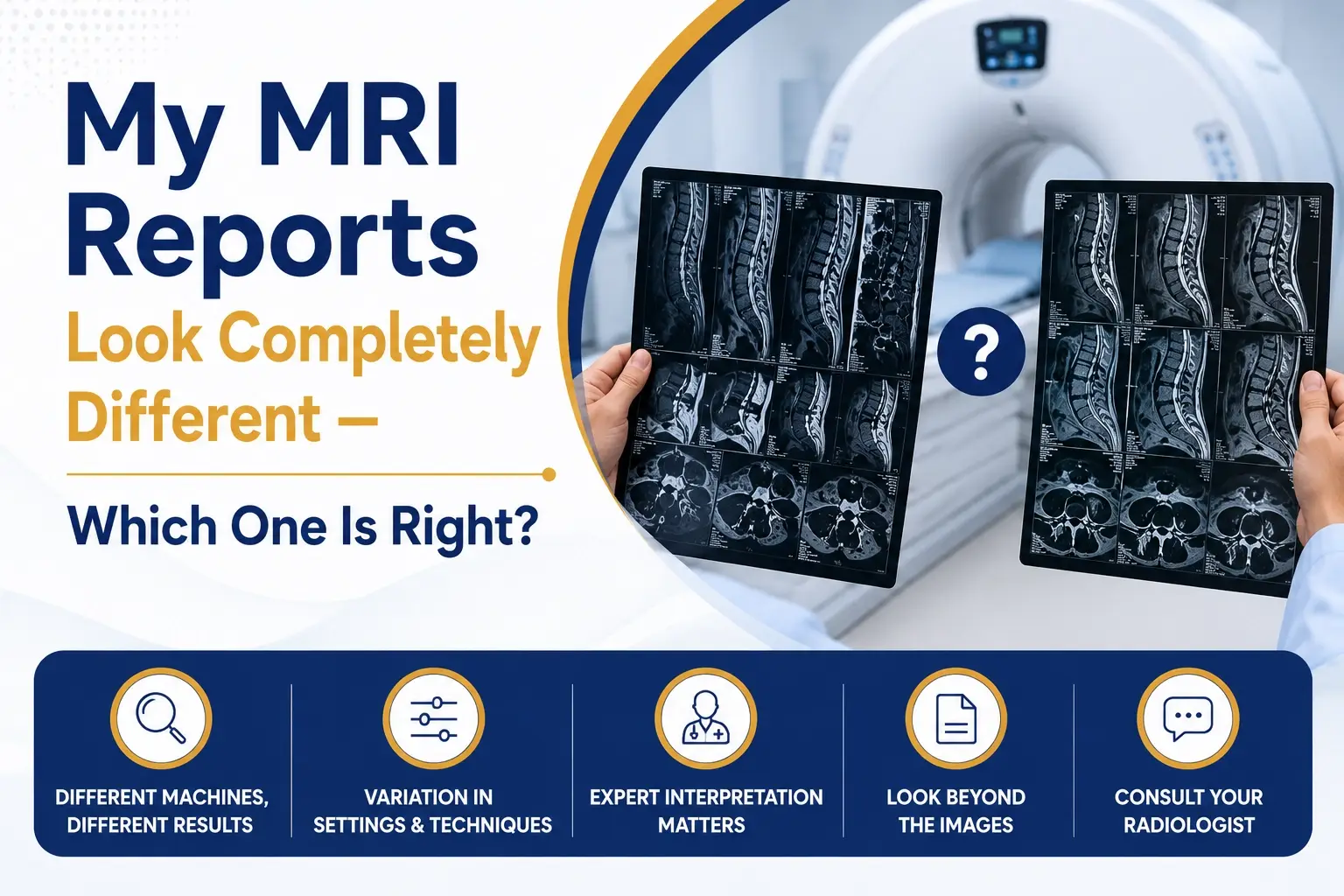
The Scan Doesn't Lie. But the Report Can Still Differ.
When you get an MRI, the machine captures thousands of detailed images of the inside of your body.
That part is objective — the camera doesn't have opinions. The images are the same wherever you go.
But here's the thing most people don't realise: someone has to look at those images and write what
they see. That person is a radiologist — a doctor who specialises in reading medical scans. And just
like any other doctor, radiologists can vary. A lot.
THINK OF IT THIS WAY
Imagine giving the same legal case to two different lawyers. The facts don't change. But the way
they read, interpret, and argue those facts — that can be very different depending on their
experience, their speciality, and how closely they look. An MRI report is the radiologist's expert
interpretation of your scan. And experts differ.
This is not a scandal. It's not a sign that radiology is unreliable. It is, however, something you deserve to
understand — because the quality of that report directly affects the advice your doctor gives you.
Why Does This Actually Happen? Here Are the Honest Answers.
1 Not all radiologists specialise in the same thing
Some radiologists read every type of scan — brain, chest, abdomen, joints — a little bit of everything.
Others spend their entire career focused on just one area. A specialist in musculoskeletal radiology
will often notice things in a knee MRI that a general radiologist simply isn't trained to spot. The images
are the same. The eyes are not.
2 Scanner quality varies enormously between hospitals
A high-end 3 Tesla MRI scanner produces sharper, more detailed images than an older 1.5 Tesla
machine. Beyond the machine itself, the settings used during your scan — how thick each 'slice' is,
which sequences are run, how long the scan takes — all affect what can be seen. If the images are
less detailed, the report will naturally have less detail.
3 The referral form matters more than you'd think
'Back pain' tells the radiologist almost nothing. 'Pain radiating down the right leg for 3 months,
suspected L4 nerve compression' tells them exactly where to look and what to look for. A radiologist
with a vague referral writes a general report. A radiologist with a specific question writes a focused,
clinically useful answer.
4 Some centres use structured reporting — most don't
Quality radiology departments use detailed report templates — standardised checklists that ensure
the radiologist comments on every important feature. Without these templates, reports are written
from memory and experience alone. Two radiologists looking at the same disc problem might use
completely different words and reach different conclusions.
5 Workload affects how carefully a scan is read
A radiologist reading 20 scans a day is in a very different state than one reading 80. Accredited
centres limit the number of scans a radiologist reads per day, require adequate time per study, and
mandate second checks for complex cases. Not every centre does this.
- A REAL EXAMPLE
What Does a 'Different Report' Actually Look Like?
Let's say you've had an MRI of your lower back for leg pain. Here's what two different reports on the
exact same scan might look like:

Same scan. Same spine. Same patient. Report A might lead your doctor to say 'you have some wear
and tear, let's wait and see.' Report B gives them a precise answer — and likely a very different
management plan. This is not a small difference.

- WHAT THIS MEANS FOR YOU
This Is Not Just About Two Pieces of Paper
The report your doctor receives from a radiologist shapes virtually every decision that follows. Which
specialist to refer you to. Whether you need surgery or can manage without it. Whether to repeat the
scan in 3 months or 3 years. Whether that shadow on your liver is nothing to worry about or something
that needs urgent attention.
An incomplete or inaccurate report doesn't just leave you uninformed — it can actively lead your care in
the wrong direction. Patients have been sent for surgery on the basis of an over-reported finding. Others
have waited months for treatment because a significant finding was described so vaguely that no one
acted on it.

- YOUR GUIDE
How to Tell If You Got a Good Report
You don't need a medical degree to recognise a well-written radiology report. Here are signs that tell
you something useful was written — or wasn't.

- IF REPORTS CONFLICT
Two Reports, Two Answers — What Do You Actually Do?
If you are in this situation right now — holding two reports that say different things — here is a calm,
practical approach:

If your doctor is unsure which report to trust, or if the conflict involves something that changes your
treatment significantly (surgery vs. no surgery, for example), the right move is a formal second opinion
— not from another hospital's general radiologist, but from a subspecialist who can review the original
scan images (called DICOM files, not just the printed report) and give a definitive read.
At Focus Diagnostics, we offer second opinion reads where our subspecialty-trained radiologists review
your original scan images directly. This is not about finding fault with another report — it is about making
sure you have the most accurate possible information before any major decision is made.
What You Can Do — Starting Right Now
You don't have to be a doctor to advocate for better care. Here are five steps anyone can take to get
more out of their radiology experience.
1 Make sure your doctor writes a specific reason on the request form
Ask to see what your doctor has written before you go for the scan. 'Back pain' is not enough. The more
specific the clinical question, the more useful the report you'll receive. It's entirely reasonable to ask:
'Can you write exactly what you're looking for on the form?'
2 Choose a NABL accredited centre — and ask if they have a subspecialist
For joints, call and ask: 'Do you have a musculoskeletal radiologist on staff?' For brain or spine: 'Is there
a neuroradiologist?' For prostate or liver: 'Do you have a body imaging specialist?' A quality centre will
be proud to answer yes.
3 Ask for your DICOM images — not just the film or the printed report
DICOM is the raw digital image file from the scanner. It contains far more information than any film print,
and if you ever need a second opinion, a radiologist needs the DICOM — not a photograph of the
images. Most quality centres will give this to you on a CD or USB drive.
4 Read your report — even if you don't understand every word
You're allowed to have a copy of your own report. Read it. If it ends with only 'clinical correlation advised'
and nothing else — ask your doctor what specific question the radiologist answered. If neither of you
can tell, that is a sign the report may not be complete enough.
5 If a major decision rests on the report — get a subspecialty second opinion
If your doctor is recommending surgery, chemotherapy, a significant lifestyle change, or prolonged
medication on the basis of an MRI report — it is completely reasonable to seek a formal second opinion
read from a subspecialty radiologist. This is not distrust. It is due diligence. Any good doctor will support
you in doing this.


You Deserve an Answer, Not a Description
great radiology report doesn't just tell you what's in the scan. It tells your doctor what it means for
you — how severe it is, whether it explains your symptoms, what should happen next. That kind of
report requires a trained expert who looks carefully, knows what to look for, and has the time and the
tools to do it properly. At Focus Diagnostics, that is the standard we hold ourselves to — because
the report is where your scan becomes your diagnosis.
Dr. Koushik Aravapally
MBBS · DMRD · DNB · EDiR · DICR
Chief Radiologist & Director, Focus Diagnostics
MSK & Interventional Radiology · Punjagutta & Kompally