Medically Reviewed By
MBBS, DCP, DNB Pathology
Pathology · Last reviewed: June 2026
Under our Editorial Policy & Medical Review Policy
RPR (Rapid Plasma Reagin) Test Hyderabad | Focus Diagnostics
Book This Test
Fill in your details and connect with our team instantly on WhatsApp.
RPR (RAPID PLASMA REAGIN) TEST
Get reliable diagnostics, expert support, and a seamless booking experience with Focus Diagnostics.
About this test
RPR (Rapid Plasma Reagin) Test
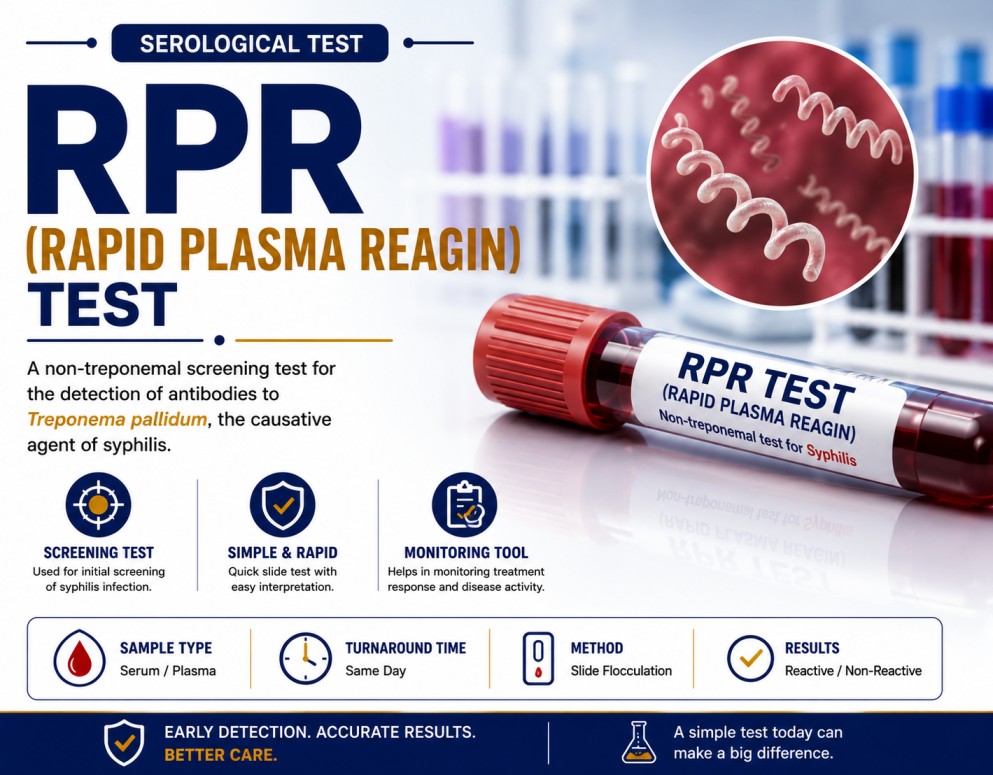
The RPR or Rapid Plasma Reagin Test is a blood test used to screen for syphilis, a sexually transmitted infection caused by the bacterium Treponema pallidum. Syphilis is curable, but untreated infection can progress through primary, secondary, latent and tertiary stages and may eventually affect the brain, nerves, eyes, heart and other organs. It can also pass from a pregnant woman to her baby and cause congenital syphilis.
RPR is classified as a non-treponemal serological test. It does not detect the syphilis bacterium directly. Instead, it detects antibodies produced against lipid-containing material released during cellular injury associated with infection.
The test may be reported as:
- Non-reactive
- Reactive
- Reactive with a titre, such as 1:2, 1:4, 1:8 or 1:32
A reactive RPR result does not confirm syphilis by itself. Diagnosis generally requires both a non-treponemal test, such as RPR or VDRL, and a treponemal-specific test, such as TPPA, TPHA, FTA-ABS or an approved treponemal immunoassay.
Syphilis may cause different symptoms depending on the stage. These may include:
- A painless genital, anal or oral ulcer
- Skin rash, including on the palms or soles
- Enlarged lymph nodes
- Fever
- Fatigue
- Sore throat
- Patchy hair loss
- Neurological or visual symptoms
- No symptoms during the latent stage
Test Purpose
The RPR test may be used to:
- Screen people for syphilis.
- Investigate symptoms suggestive of syphilis.
- Test sexual partners or contacts of infected individuals.
- Screen pregnant women.
- Support preoperative, employment or institutional screening where required.
- Measure baseline antibody titres before treatment.
- Monitor the response to syphilis treatment.
- Help identify possible reinfection.
One of the main clinical advantages of RPR is that its titre can be followed over time. A clinically significant change is generally assessed using a fourfold change in titre, equivalent to a change of two dilution steps—for example, from 1:32 to 1:8. RPR titres are useful for monitoring, whereas treponemal antibody titres should not be used to assess treatment response.
Benefits of the Test
- Simple blood-based screening test.
- Useful for identifying possible active syphilis.
- Can be reported quantitatively as an antibody titre.
- Helps monitor treatment response.
- Useful during pregnancy screening.
- Can support the detection of reinfection.
- Widely available in diagnostic laboratories.
- Often included in routine STI evaluation.
Why Doctors Recommend It
Doctors may recommend an RPR test when a patient has a genital ulcer, unexplained rash, known exposure to syphilis, a new sexual partner, multiple sexual partners or another sexually transmitted infection.
Testing is particularly important during pregnancy because untreated maternal infection can lead to miscarriage, stillbirth, premature delivery or congenital syphilis. WHO recommends that pregnant women be tested for syphilis during antenatal care.
Preparation
No fasting or special dietary preparation is required.
Inform the healthcare provider about:
- Recent sexual exposure
- Previous syphilis infection or treatment
- Pregnancy
- Autoimmune disease
- Recent vaccination or infection
- HIV status
- Current symptoms
- Previous RPR or VDRL results
A venous blood sample is collected, and serum or plasma is tested according to the laboratory method.
Reporting Time
Typically: Same day or within 24 hours
Quantitative titre testing or reflex confirmatory testing may require additional time.
Who Should Take the Test?
The test may be recommended for:
- People with symptoms suggestive of syphilis
- Sexual partners of people diagnosed with syphilis
- Pregnant women
- People with a new or multiple sexual partners
- Individuals diagnosed with another STI
- People living with HIV
- Individuals with unexplained neurological or visual symptoms
- Patients requiring follow-up after syphilis treatment
- People undergoing STI screening
- Anyone advised by a qualified healthcare professional
Test FAQs
What is the RPR test?
What does a reactive RPR result mean?
Does a reactive RPR confirm syphilis?
What does a non-reactive RPR result mean?
What is an RPR titre?
Can RPR be used to monitor syphilis treatment?
Can RPR produce a false-positive result?
Do I need to fast before the test?
What confirmatory tests may be performed after a reactive RPR?
Can the RPR test detect neurosyphilis?
RPR (RAPID PLASMA REAGIN) TEST
Rs. 280
Explore Related Tests & Services
Find Your Nearest Focus Diagnostic Centre Hyderabad
Popular Lab Tests in Other Cities
Telangana
Andhra Pradesh
Book Your lab tests instantly
Accurate reports and home sample collection across Hyderabad