D-Dimer Test: Why Is It Done, Normal Range, High Levels & Blood Clot Detection
By Focus Diagnostics
9 min read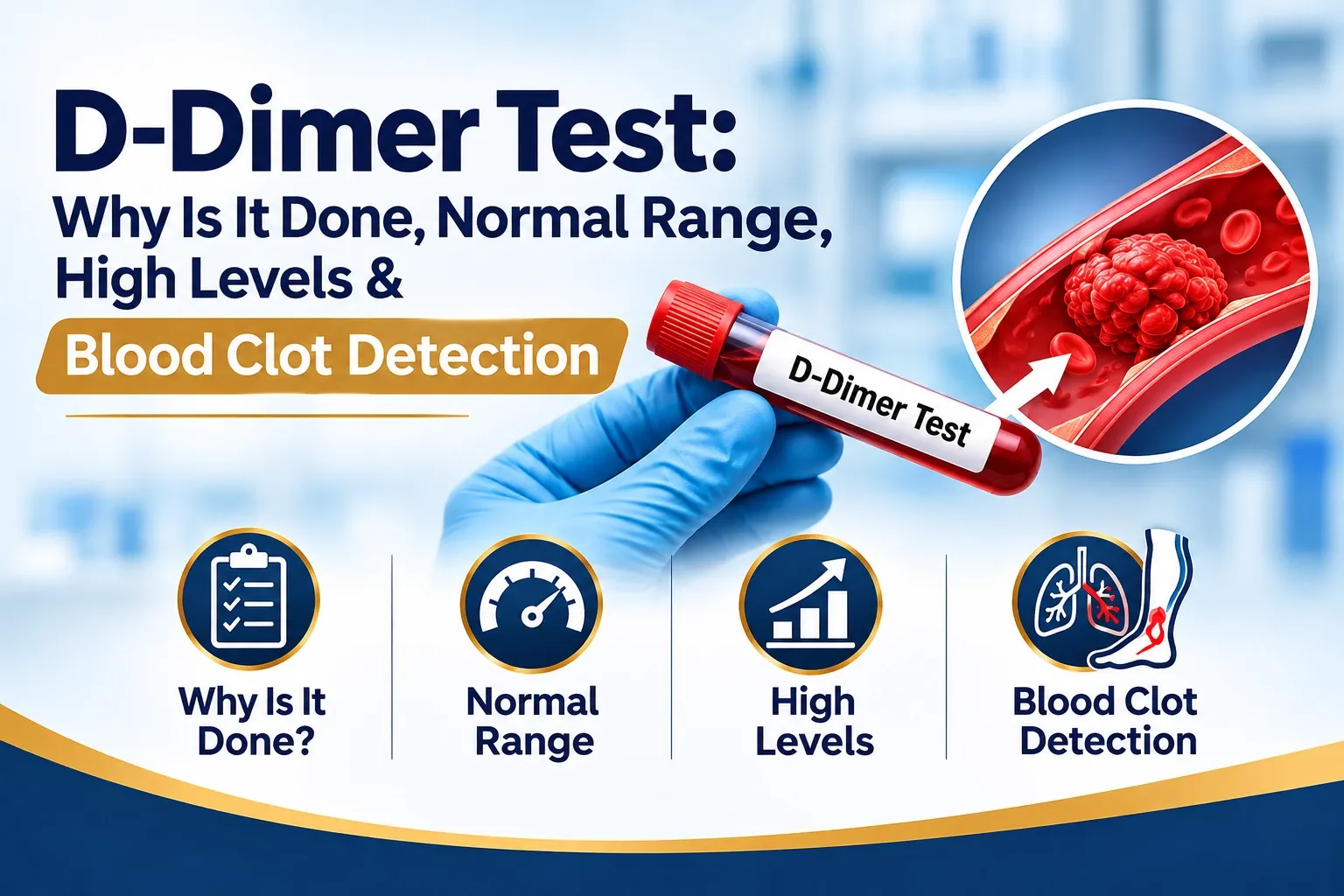
Understanding the D-Dimer Blood Test
Section heading · H2 · 26 px · Bold
Blood clotting is an important process that prevents excessive bleeding when a blood vessel is injured. However, abnormal clot formation inside blood vessels can sometimes lead to serious medical conditions.
The D-Dimer Test is a blood test that measures fragments released when the body breaks down a blood clot. It helps doctors assess whether abnormal clot formation and breakdown may be occurring in the body.
Doctors commonly use this test when investigating conditions such as Deep Vein Thrombosis (DVT) and Pulmonary Embolism (PE). Understanding D-Dimer levels, normal reference ranges and possible causes of elevated results can help patients understand why this investigation may be recommended.
An elevated D-Dimer result does not automatically confirm a blood clot. It must be interpreted alongside symptoms, medical history and other investigations.
What Is a D-Dimer Test?
H2 · 26 px
D-Dimer is a protein fragment produced when the body breaks down cross-linked fibrin, a protein involved in forming blood clots.
When a clot forms, the body activates a natural process called fibrinolysis, which helps dissolve the clot. During this process, D-Dimer fragments are released into the bloodstream.
A D-Dimer blood test measures these fragments to identify increased clot formation and breakdown activity.
What the test helps evaluate:
- Possible abnormal blood clot formation and breakdown.
- Suspected deep vein thrombosis.
- Suspected pulmonary embolism.
- Certain clotting disorders, including disseminated intravascular coagulation (DIC).
- Selected situations where doctors need to investigate abnormal coagulation activity.
The test is particularly useful when interpreted together with a patient's clinical risk assessment.
Why Is a D-Dimer Test Done?
H2 · 26 px
Doctors may recommend a D-Dimer test when symptoms or clinical findings raise suspicion of abnormal blood clot formation.
Common reasons include:
- Unexplained swelling or pain in one leg.
- Suspected deep vein thrombosis.
- Sudden breathlessness or chest discomfort requiring evaluation for pulmonary embolism.
- Suspected abnormal blood clotting activity.
- Evaluation of certain patients with suspected disseminated intravascular coagulation.
- Assessment of suspected clotting conditions alongside other clinical investigations.
The test is not intended as a routine screening test for every healthy person. Doctors generally use it when there is a specific clinical reason to investigate possible clotting abnormalities.
D-Dimer Normal Range and Reference Values
H2 · 26 px
A D-Dimer result is generally reported as a numerical value with a reference range or cut-off provided by the laboratory.
A commonly used threshold for many assays is:
≤ 500 ng/mL FEU
Common reference cut-off
Equivalent to 0.5 mg/L FEU in commonly used assays.
However, D-Dimer reference ranges can vary depending on the testing method, laboratory and reporting units. Some laboratories report FEU (Fibrinogen Equivalent Units), while others use DDU (D-Dimer Units). These values are not numerically interchangeable.
Important points when interpreting the result:
- A result below the laboratory cut-off may help exclude DVT or PE in patients with appropriate low or intermediate clinical probability.
- A result above the reference cut-off is considered elevated and may require further evaluation.
- Age-adjusted cut-offs may be used in selected patients, particularly adults above 50 years, under validated clinical pathways.
- The reference range printed on the actual laboratory report should always be considered.
Age-adjusted D-Dimer interpretation
In certain validated pathways for suspected pulmonary embolism, an age-adjusted threshold may be calculated for patients above 50 years:
Age × 10 ng/mL FEU
For example, for a person aged 65 years, the age-adjusted threshold would be 650 ng/mL FEU.
This approach is not a universal reference range for every patient or every assay. It should only be applied by clinicians using an appropriate diagnostic pathway.
What Does a High D-Dimer Level Mean?
H2 · 26 px
A high D-Dimer result indicates increased fibrin formation and breakdown activity in the body. It may occur when an abnormal blood clot is present, but several other conditions can also increase D-Dimer levels.
Possible causes of elevated D-Dimer include:
- Deep vein thrombosis (DVT).
- Pulmonary embolism (PE).
- Recent surgery or physical trauma.
- Pregnancy and the postpartum period.
- Infections and inflammatory conditions.
- Certain cancers.
- Liver disease.
- Disseminated intravascular coagulation (DIC).
- Increasing age.
Does a high D-Dimer always mean a blood clot?
No. An elevated result alone cannot confirm the presence, location or severity of a blood clot. Doctors may recommend additional investigations, such as venous Doppler ultrasound or CT pulmonary angiography, depending on the suspected condition.
The degree of elevation also does not reliably indicate how severe a clotting condition is.
How Does D-Dimer Help Detect Blood Clots?
H2 · 26 px
D-Dimer testing is commonly used as part of the diagnostic process when doctors suspect blood clots.
Deep Vein Thrombosis (DVT)
DVT occurs when a blood clot forms in a deep vein, commonly in the lower limb. It may cause:
- Swelling in one leg.
- Pain or tenderness.
- Warmth around the affected area.
- Redness or changes in skin colour.
A D-Dimer test may help assess the possibility of DVT. Depending on the clinical probability and test result, a doctor may recommend a Venous Doppler Ultrasound to examine the veins.
Pulmonary Embolism (PE)
Pulmonary embolism occurs when a blood clot blocks an artery in the lungs. It can be life-threatening and requires urgent medical assessment.
Possible symptoms include:
- Sudden shortness of breath.
- Chest pain, especially when breathing deeply.
- Rapid heartbeat.
- Coughing, sometimes with blood.
- Dizziness or fainting.
A D-Dimer test may help exclude PE in appropriately selected patients with low or intermediate clinical probability. If PE is suspected at higher clinical probability, doctors may proceed directly to appropriate imaging rather than relying on D-Dimer testing.
Emergency warning: Sudden breathlessness, chest pain, fainting or coughing up blood requires immediate medical attention. Do not wait for a D-Dimer test.
When Should You Consider a D-Dimer Test?
H2 · 26 px
A D-Dimer test may be recommended when a doctor identifies symptoms or risk factors that warrant investigation for abnormal blood clotting.
Situations that may require medical assessment include:
- Unexplained swelling in one leg.
- Persistent leg pain or tenderness.
- Recent surgery or prolonged immobility accompanied by concerning symptoms.
- Sudden respiratory symptoms that may suggest a pulmonary embolism.
- Clinical suspicion of a clotting disorder.
People with certain medical conditions may have an increased risk of blood clots. However, symptoms and individual risk factors must be assessed by a healthcare professional before deciding whether testing is necessary.
How Is the D-Dimer Blood Test Performed?
H2 · 26 px
The D-Dimer test is a simple laboratory blood investigation performed using a blood sample collected from a vein, usually in the arm.
During the test:
- A healthcare professional identifies a suitable vein.
- The skin is cleaned before sample collection.
- A blood sample is collected using a sterile needle.
- The sample is transferred into the appropriate collection tube.
- The laboratory analyses the sample using a validated D-Dimer testing method.
The blood collection usually takes only a few minutes. Some people may experience mild discomfort or temporary bruising at the collection site.
Is fasting required?
No special fasting or dietary preparation is generally required for a D-Dimer test. Follow any specific instructions provided by your doctor or diagnostic laboratory.
What Is the Difference Between a D-Dimer Test and a Doppler Ultrasound?
H2 · 26 px
Both investigations can play important roles when doctors evaluate suspected blood clots, but they provide different information.
D-Dimer Test
- A blood test that measures fibrin breakdown fragments.
- Helps assess the possibility of abnormal clotting activity.
- Cannot identify the exact location of a blood clot.
- May help rule out DVT or PE in appropriately selected patients.
Doppler Ultrasound
- An imaging examination that evaluates blood flow through selected vessels.
- Can help identify DVT in accessible veins.
- Provides information about blood-flow patterns and vessel characteristics.
- May be recommended following an elevated D-Dimer result or based on clinical assessment.
Both tests serve different diagnostic purposes. The doctor determines which investigation is appropriate based on the patient's symptoms and clinical probability.
Factors That Can Affect D-Dimer Results
H2 · 26 px
D-Dimer levels may increase due to several conditions unrelated to an acute blood clot. This is one reason why the test has limited specificity.
Factors that may influence results include:
- Pregnancy and recent childbirth.
- Older age.
- Recent surgery or injury.
- Infection or inflammation.
- Certain cancers.
- Liver disease.
- Blood-thinning medication and other clinical factors that may affect interpretation.
A normal result may also be less reliable in some circumstances, including certain patients already receiving anticoagulant treatment or when testing is performed at an inappropriate stage of illness.
Therefore, D-Dimer results should never be interpreted in isolation.
D-Dimer Test in Hyderabad at Focus Diagnostics
H2 · 26 px
If your doctor has recommended a D-Dimer blood test in Hyderabad, Focus Diagnostics can help you enquire about the laboratory investigation, sample collection and appointment availability.
Patients can contact Focus Diagnostics to confirm the availability of the test at their preferred diagnostic centre.
Focus Diagnostics locations:
- Punjagutta, Hyderabad.
- Kompally, Hyderabad.
- Khajaguda, Hyderabad.
Before visiting, confirm test availability and any specific sample collection instructions with the centre.
Understanding your D-Dimer report with your treating doctor can help determine whether further investigations are required.
Frequently Asked Questions About the D-Dimer Test
H2 · 26 px
What is a D-Dimer blood test used for?
The D-Dimer test measures fragments released during blood clot breakdown. It helps doctors evaluate suspected clotting conditions such as deep vein thrombosis and pulmonary embolism.
What is the normal D-Dimer range?
A commonly used cut-off is 500 ng/mL FEU or less. However, the normal range depends on the laboratory assay, reporting units and clinical context.
Does a high D-Dimer mean I have a blood clot?
No. High D-Dimer levels can occur due to blood clots, pregnancy, infections, inflammation, recent surgery and other conditions. Additional clinical assessment is necessary.
Can a D-Dimer test detect DVT?
It helps evaluate the possibility of DVT, particularly in patients with appropriate clinical probability. Venous Doppler ultrasound may be required to investigate the suspected clot.
Can a D-Dimer test detect pulmonary embolism?
It can help exclude pulmonary embolism in appropriately selected patients with low or intermediate clinical probability. Additional imaging may be required when PE is suspected.
Is fasting required before a D-Dimer test?
No special fasting is generally required. Follow any instructions provided by your doctor or diagnostic centre.
Can pregnancy increase D-Dimer levels?
Yes. D-Dimer levels naturally increase during pregnancy and the postpartum period. Results require pregnancy-specific clinical interpretation.
Can infection cause high D-Dimer levels?
Yes. Infections and inflammatory conditions can increase D-Dimer levels even when an acute blood clot is not present.
How is a D-Dimer test performed?
A blood sample is collected from a vein, usually in the arm, and analysed in a laboratory using a D-Dimer testing method.
Where can I enquire about a D-Dimer test in Hyderabad?
You can contact Focus Diagnostics to enquire about D-Dimer testing, sample collection and availability at its Hyderabad diagnostic centres.
Conclusion
The D-Dimer test is an important blood investigation used to evaluate abnormal clot formation and breakdown. It can help doctors assess suspected deep vein thrombosis, pulmonary embolism and selected clotting disorders.
Understanding the D-Dimer normal range, elevated levels and possible causes of abnormal results can help patients better understand their laboratory reports. However, an elevated result does not independently confirm a blood clot.
If your doctor has recommended a D-Dimer test in Hyderabad, contact Focus Diagnostics to enquire about test availability and sample collection. Always consult your treating doctor for accurate interpretation and further medical guidance.