Meckel's Diverticulum Scan in Hyderabad: Procedure, Uses and Nuclear Medicine Diagnosis of Gastrointestinal Bleeding
By Focus Diagnostics
8 min read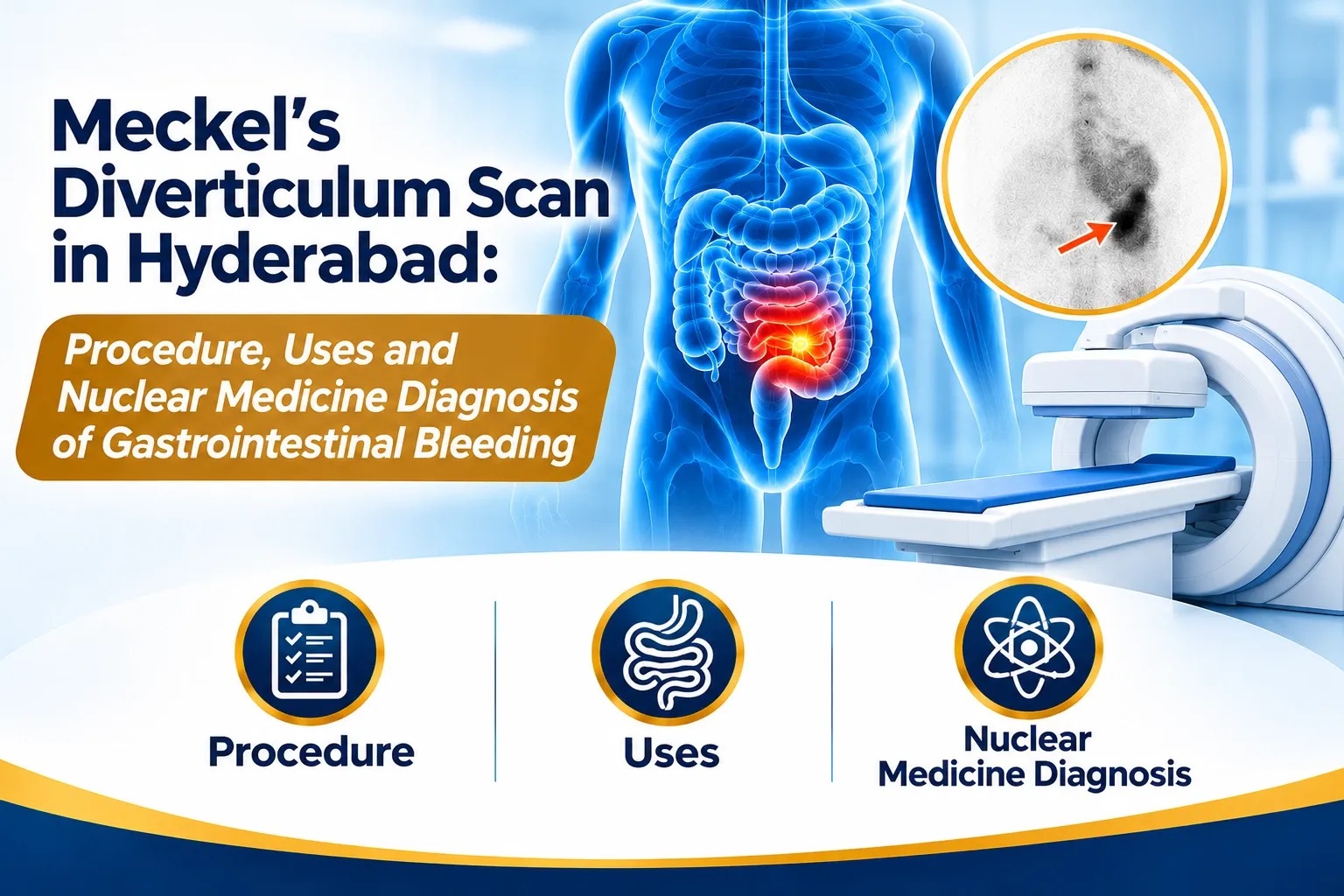
Meckel's Diverticulum Scan in Hyderabad: Procedure, Uses and Nuclear Medicine Diagnosis of Gastrointestinal Bleeding
Unexplained gastrointestinal bleeding, particularly in children, may sometimes be associated with an underlying abnormality in the small intestine. One such condition is Meckel's diverticulum, a congenital abnormality that can contain gastric tissue outside its normal location.
Identifying this condition can be challenging because its symptoms may resemble those of other gastrointestinal disorders.
A Meckel's Diverticulum Scan, also known as Meckel scintigraphy, is a specialized nuclear medicine investigation that helps detect ectopic gastric mucosa using a radioactive tracer called Technetium-99m pertechnetate.
For patients and parents searching for a Meckel scan in Hyderabad, understanding the procedure, its diagnostic purpose and preparation requirements can help them make informed decisions about the investigation.
What Is Meckel's Diverticulum?
Meckel's diverticulum is a congenital pouch-like abnormality of the small intestine, usually located in the ileum.
It develops due to incomplete closure of the vitelline duct, also known as the omphalomesenteric duct, during fetal development.
Many people with Meckel's diverticulum never develop symptoms. However, some individuals may experience complications, including:
- Painless gastrointestinal bleeding.
- Abdominal pain.
- Intestinal obstruction.
- Inflammation of the diverticulum.
- Ulceration of the adjacent intestinal lining.
One important feature is the presence of ectopic gastric mucosa, meaning stomach-like tissue located outside the stomach.
This tissue can produce acid and contribute to ulceration and gastrointestinal bleeding.
What Is a Meckel's Diverticulum Scan?
A Meckel scan is a nuclear medicine imaging examination primarily used to identify functioning ectopic gastric mucosa associated with a suspected Meckel's diverticulum.
The investigation uses Technetium-99m sodium pertechnetate (Tc-99m pertechnetate) as the radiopharmaceutical.
This tracer is taken up by mucus-producing cells of gastric mucosa, including ectopic gastric tissue.
A gamma camera detects the emitted radiation and captures sequential abdominal images.
If functioning ectopic gastric mucosa is present, an abnormal focus of tracer accumulation may be identified during the examination.
This helps nuclear medicine specialists assess whether a Meckel's diverticulum could be responsible for the patient's symptoms.
Why Do Doctors Recommend a Meckel Scan?
A doctor may recommend Meckel scintigraphy when clinical findings suggest the possibility of ectopic gastric mucosa.
Common clinical indications include:
1. Unexplained Gastrointestinal Bleeding
Meckel's diverticulum is an important cause of lower gastrointestinal bleeding in children.
A Meckel scan can help identify functioning gastric mucosa within a suspected diverticulum.
2. Painless Rectal Bleeding in Children
Some children with Meckel's diverticulum may develop painless bleeding due to ulceration in the adjacent small intestine.
Nuclear medicine imaging may help investigate this possibility.
3. Suspected Ectopic Gastric Mucosa
The scan is specifically designed to identify functioning gastric mucosal tissue outside the stomach.
4. Investigation of Suspected Meckel's Diverticulum
When clinical examination and other investigations suggest a possible Meckel's diverticulum, scintigraphy may provide additional diagnostic information.
5. Evaluation of Selected Congenital Gastrointestinal Abnormalities
In selected cases, the investigation may help identify other sites of ectopic gastric mucosa.
The scan should be selected according to the patient's clinical presentation and the treating doctor's recommendation.
How Does a Meckel Scan Work?
Meckel scintigraphy works through the physiological uptake of Tc-99m pertechnetate by gastric mucosal cells.
The tracer circulates through the bloodstream and is taken up by functioning gastric mucosa.
When ectopic gastric tissue is present in a Meckel's diverticulum, it may demonstrate tracer accumulation similar to that of the normal stomach.
A gamma camera records the distribution of the radiotracer over time.
The nuclear medicine specialist evaluates the timing, location and pattern of tracer activity to identify findings suggestive of ectopic gastric mucosa.
Meckel Scan Procedure: Step by Step
The examination generally involves the following stages:
Step 1: Patient Assessment
The imaging team reviews the patient's symptoms, medical history, previous investigations and doctor's prescription.
Information about previous gastrointestinal bleeding, abdominal procedures and recent nuclear medicine examinations is important.
Step 2: Patient Preparation
Preparation instructions are provided according to the imaging protocol.
In many protocols, a short fasting period of approximately 3–4 hours may be recommended to improve image interpretation.
Step 3: Radiotracer Administration
A small quantity of Tc-99m pertechnetate is administered through an intravenous injection.
Step 4: Dynamic Imaging
The patient lies comfortably on the imaging table while the gamma camera captures sequential images of the abdomen.
Dynamic imaging helps evaluate tracer movement and identify abnormal accumulation.
Step 5: Additional Imaging
Additional static or lateral images may be obtained to distinguish suspected ectopic gastric activity from normal structures and urinary activity.
Step 6: Image Interpretation
A nuclear medicine specialist reviews the images and prepares a report based on tracer distribution and clinical information.
What Is Tc-99m Pertechnetate and Why Is It Used?
Technetium-99m pertechnetate is a radiopharmaceutical commonly used for Meckel scintigraphy.
Its diagnostic importance is based on its uptake by functioning gastric mucosal cells.
The radiotracer allows the imaging team to visualize gastric mucosa even when it is located outside the normal stomach.
Important characteristics include:
- It is administered intravenously.
- It is taken up by functioning gastric mucosal tissue.
- It emits gamma radiation detectable by a gamma camera.
- It allows dynamic imaging of tracer distribution.
- It helps identify ectopic gastric mucosa in appropriately selected patients.
The scan is particularly useful when a suspected Meckel's diverticulum contains functioning gastric tissue.
What Does a Positive Meckel Scan Mean?
A positive Meckel scan generally demonstrates an abnormal focus of radiotracer accumulation outside the normal stomach.
A characteristic finding is focal activity that appears at approximately the same time as gastric activity and increases in a similar pattern.
The location and appearance of the abnormal activity are assessed carefully.
However, not every focus of abdominal tracer activity represents a Meckel's diverticulum.
Normal bowel activity, urinary activity and other sources of tracer accumulation must be considered during interpretation.
A positive finding should be correlated with the patient's symptoms and other clinical investigations.
Can a Negative Meckel Scan Rule Out Meckel's Diverticulum?
A negative Meckel scan does not completely exclude the presence of a Meckel's diverticulum.
The investigation detects functioning ectopic gastric mucosa rather than every anatomical diverticulum.
False-negative findings may occur when:
- The diverticulum contains little or no functioning gastric mucosa.
- There is impaired blood supply to the ectopic tissue.
- Tracer uptake is insufficient for detection.
- Technical or patient-related factors affect image quality.
If clinical suspicion remains high, the treating doctor may recommend additional investigations or further evaluation.
Meckel Scan vs Gastrointestinal Bleeding Scan
These are different nuclear medicine examinations designed to answer different clinical questions.
FeatureMeckel ScanGI Bleeding ScanPrimary purposeDetect ectopic gastric mucosaLocalize active gastrointestinal bleedingCommon tracerTc-99m pertechnetateTc-99m-labelled red blood cellsMain clinical useSuspected Meckel's diverticulumSuspected active or intermittent bleedingImaging approachDynamic abdominal scintigraphySerial abdominal imagingDiagnostic targetFunctioning gastric mucosaBlood loss into the gastrointestinal tract
The treating doctor selects the appropriate investigation according to whether the suspected problem is ectopic gastric tissue or active gastrointestinal bleeding.
How Should Patients Prepare for a Meckel Scan?
Preparation can influence image quality and diagnostic sensitivity.
Patients or parents may be advised to:
- Follow the fasting instructions provided by the nuclear medicine department.
- Carry the doctor's referral and previous investigation reports.
- Inform the team about recent barium examinations.
- Disclose any recent nuclear medicine scans, particularly radiolabelled red blood cell studies.
- Inform the medical team about all medications.
- Disclose pregnancy or possible pregnancy where relevant.
- Follow any additional medication preparation prescribed by the specialist.
Certain medications may be used under medical supervision to improve tracer retention in gastric mucosa.
Never start, stop or change medication without instructions from the treating doctor.
Is a Meckel Scan Safe?
Meckel scintigraphy is an established diagnostic nuclear medicine investigation.
It involves administering a small diagnostic quantity of Tc-99m pertechnetate.
The radiation exposure depends on the administered activity and patient-specific imaging protocol.
The procedure is generally well tolerated. Some patients may experience minor discomfort at the intravenous injection site.
Pregnancy and breastfeeding should be discussed with the nuclear medicine team before the examination.
For children, the radiopharmaceutical activity is calculated according to appropriate paediatric protocols.
Where Can You Enquire About a Meckel Scan in Hyderabad?
A Meckel scan is a specialized nuclear medicine investigation, and its availability may vary between diagnostic facilities.
Patients and parents should confirm the prescribed investigation, age-specific preparation instructions, appointment availability and imaging protocol before visiting a diagnostic centre.
Focus Diagnostics provides diagnostic imaging and laboratory services in Hyderabad.
You can contact the team to enquire about nuclear medicine investigation availability and appointment guidance.
Focus Diagnostics
Phone / WhatsApp: 91213 77123
Always confirm whether the specific Meckel scintigraphy examination is available before scheduling your visit.
Frequently Asked Questions About Meckel's Diverticulum Scan
1. What does a Meckel scan detect?
A Meckel scan detects functioning ectopic gastric mucosa using Tc-99m pertechnetate. It helps investigate suspected Meckel's diverticulum, particularly in patients with unexplained gastrointestinal bleeding.
2. Why is a Meckel scan commonly recommended for children?
Meckel's diverticulum is an important cause of painless lower gastrointestinal bleeding in children. Scintigraphy can help identify ectopic gastric mucosa that may be responsible for the bleeding.
3. Is fasting required before a Meckel scan?
A short fasting period, commonly around 3–4 hours, may be recommended depending on the protocol. Patients should follow the specific instructions provided by their nuclear medicine team.
4. Does a negative Meckel scan completely rule out Meckel's diverticulum?
No. The scan primarily identifies functioning ectopic gastric mucosa. A diverticulum without sufficient functioning gastric tissue may not be detected.
5. Where can I enquire about a Meckel scan in Hyderabad?
You can contact Focus Diagnostics at 91213 77123 or visitto enquire about nuclear medicine investigation availability and appointment guidance.
Conclusion
Meckel's diverticulum scintigraphy is a specialized nuclear medicine examination that helps identify functioning ectopic gastric mucosa using Technetium-99m pertechnetate.
It plays an important role in evaluating selected patients, particularly children with unexplained gastrointestinal bleeding and suspected Meckel's diverticulum.
Understanding the procedure, preparation requirements and diagnostic limitations can help patients and parents make informed decisions about gastrointestinal investigations.
Focus Diagnostics – Supporting Better Healthcare Decisions Through Reliable Diagnostic Services.