What Happens at Integrated Diagnostics at Focus Diagnostics: From Scan to Diagnosis to Treatment in 72 Hours
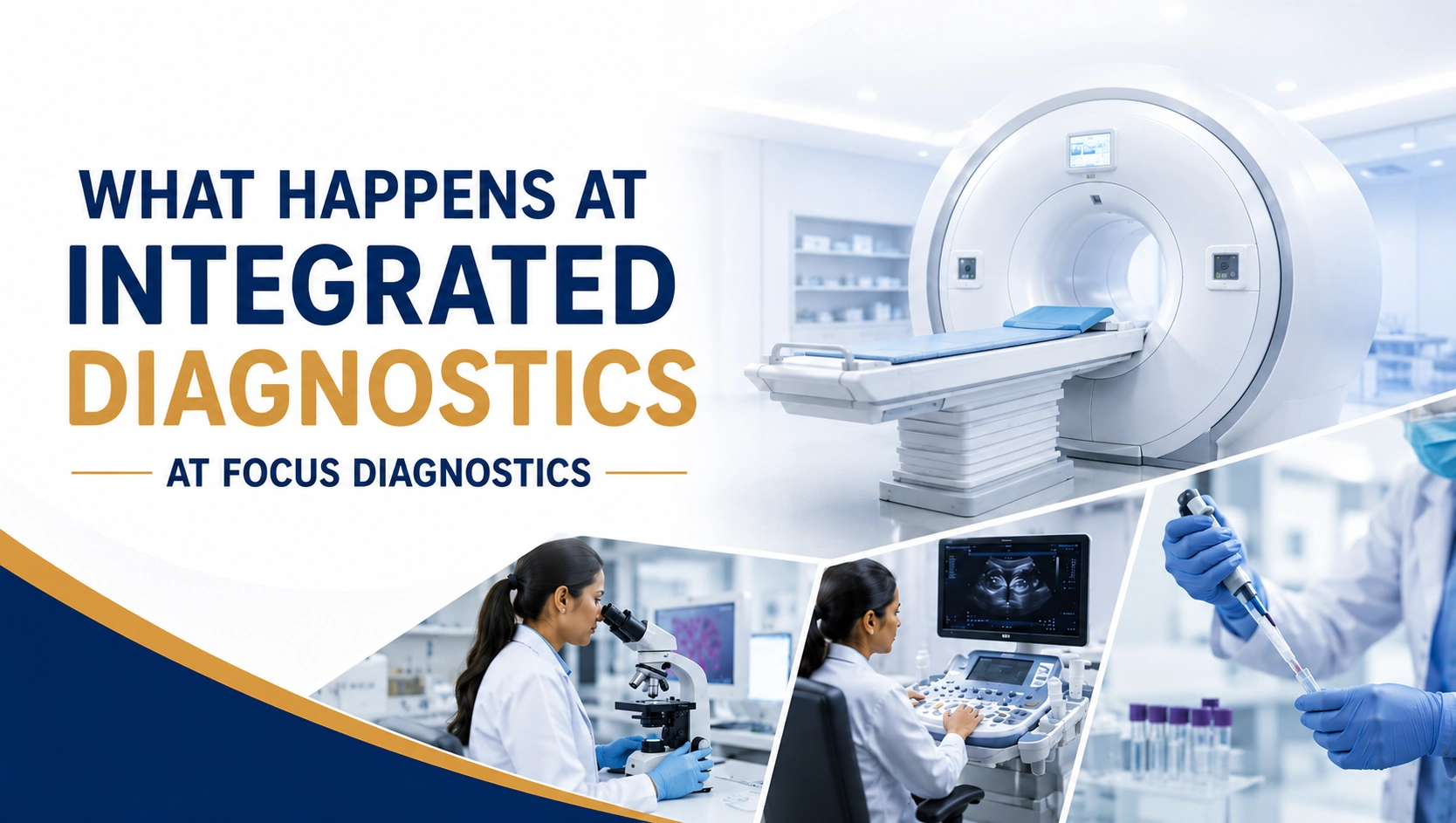
What Happens at Integrated Diagnostics at Focus Diagnostics
From Scan to Diagnosis to Treatment — in 72 Hours
When patients receive unexpected findings during a medical scan, time becomes one of the most valuable factors in healthcare. Unfortunately, many conventional diagnostic pathways require patients to move between multiple hospitals, laboratories, biopsy centres, and specialist clinics before a final diagnosis is confirmed. This fragmented approach often results in unnecessary delays, prolonged anxiety, repeated appointments, and postponed treatment.
Focus Diagnostics was built to solve this problem through an integrated diagnostic model that combines advanced imaging, image-guided interventions, pathology, and rapid specialist communication within one coordinated healthcare system.
Instead of waiting one to two weeks for reports from multiple facilities, patients can now move from initial imaging to confirmed diagnosis and treatment planning within just 48 to 72 hours.
This integrated approach improves clinical efficiency while significantly reducing the emotional burden experienced by patients and their families.
A patient who enters Focus Diagnostics for a routine scan is not simply receiving an imaging report—they are entering a coordinated diagnostic pathway designed to deliver answers quickly, accurately, and safely.
Case One: Breast Lump Diagnosed Within Three Days
A 50-year-old woman visited Focus Diagnostics after noticing a lump in her left breast for approximately two weeks.
A high-resolution breast ultrasound was performed by a dedicated breast imaging radiologist. The scan demonstrated an irregular hypoechoic mass with angular margins and posterior acoustic shadowing. Based on established imaging criteria, the lesion was categorized as BI-RADS 5, indicating a high suspicion for malignancy.
Rather than asking the patient to schedule another appointment elsewhere, the consultant radiologist immediately communicated the findings directly with the treating clinician.
Later the same day, an ultrasound-guided core needle biopsy was performed using real-time imaging guidance. Tissue samples were immediately transferred to the pathology department within the same integrated system.
Within 48 hours, histopathology confirmed Invasive Ductal Carcinoma Grade II.
Immunohistochemistry (IHC) testing was completed simultaneously, revealing:
- ER Positive
- PR Positive
- HER2 Negative
- Luminal A subtype
With complete pathology and receptor profiling available almost immediately, the surgical oncologist was able to begin definitive treatment planning by Day Three.
In many traditional healthcare settings, this process alone may require several separate appointments across multiple facilities and often extends beyond two weeks.
Case Two: Thyroid Nodule Diagnosed Without Delay
A 44-year-old male presented with a painless swelling in the neck after referral from his general physician.
High-resolution thyroid ultrasound identified a 1.8 cm solid hypoechoic thyroid nodule with irregular margins and microcalcifications. The lesion was classified as TI-RADS 5, suggesting a high probability of thyroid malignancy.
Images were digitally shared with the referring physician immediately after the examination.
During the same hospital visit, the patient underwent an ultrasound-guided Fine Needle Aspiration Cytology (FNAC). Because imaging and intervention were available in one location, there was no need for additional appointments or referrals.
The cytopathology report was completed the following day and categorized as Bethesda Category V, indicating suspicion for Papillary Thyroid Carcinoma.
With imaging, cytology, and neck mapping already available, the patient met the surgical oncologist on Day Three to begin thyroidectomy planning.
Instead of waiting weeks for multiple reports, diagnosis and surgical consultation were completed within three days.
Case Three: Liver Lesion Detected During Routine Screening
A 58-year-old woman attended Focus Diagnostics for her annual corporate preventive health screening.
Routine abdominal ultrasound unexpectedly revealed a previously unseen 2.4 cm lesion in the right lobe of the liver.
Recognizing the significance of this finding, the patient was immediately referred to a subspecialty body imaging radiologist within the same diagnostic centre.
A Contrast Enhanced Ultrasound (CEUS) was performed later that day.
The enhancement characteristics demonstrated arterial hyperenhancement followed by rapid washout, highly suggestive of Hepatocellular Carcinoma (HCC).
An ultrasound-guided liver biopsy was scheduled for the following morning.
The biopsy was completed safely under real-time ultrasound guidance without complications.
Histopathology confirmed well-differentiated Hepatocellular Carcinoma on Day Three.
The patient was then referred to hepatology and surgical gastroenterology with complete imaging, pathology reports, and staging recommendations already prepared.
Early detection through routine screening made timely treatment possible before the disease progressed further.
Why Integrated Diagnostics Makes a Difference
The traditional diagnostic journey often involves several independent healthcare providers.
Patients may visit one centre for imaging, another for biopsy, a third laboratory for pathology, and finally return to their physician after waiting several days or weeks.
Each transition introduces delays, repeated paperwork, additional travel, increased costs, and considerable emotional stress.
Integrated diagnostics eliminates these barriers.
At Focus Diagnostics, radiologists, pathologists, intervention specialists, and referring clinicians function as one coordinated team.
Critical findings are communicated immediately.
Biopsies are performed without unnecessary referrals.
Pathology receives tissue samples without transportation delays.
Treatment planning begins as soon as diagnostic confirmation becomes available.
The result is a streamlined patient experience focused on faster clinical decision-making and better outcomes.
The Technology Behind the Process
Focus Diagnostics combines multiple advanced diagnostic capabilities under one roof.
These include:
- High-resolution subspecialty ultrasound imaging
- Ultrasound-guided biopsies
- Fine Needle Aspiration Cytology (FNAC)
- Contrast Enhanced Ultrasound (CEUS)
- Histopathology
- Immunohistochemistry (IHC)
- Digital image sharing
- Real-time clinician communication
- Multidisciplinary reporting
Every department operates as part of one integrated clinical workflow rather than isolated services.
Commitment to Quality
Speed alone is not enough.
Every investigation performed at Focus Diagnostics follows strict NABL-accredited quality standards.
Each imaging study undergoes expert interpretation by experienced subspecialty radiologists.
Biopsy procedures are performed under real-time imaging guidance for maximum precision.
Pathology reports undergo rigorous quality assurance before release.
Rapid turnaround never compromises diagnostic accuracy.
Instead, technology, standardized workflows, and coordinated communication allow both speed and precision to work together.
Better Outcomes Through Early Diagnosis
Early diagnosis remains one of the strongest predictors of successful treatment for many cancers and serious diseases.
When suspicious findings are identified quickly and confirmed without unnecessary delay, patients gain access to specialists sooner.
Earlier treatment planning can improve surgical outcomes, reduce disease progression, minimize patient anxiety, and provide families with timely clinical guidance.
Integrated diagnostics helps transform uncertainty into informed medical decision-making within days instead of weeks.
The Future of Diagnostic Healthcare
Healthcare continues to evolve beyond isolated diagnostic tests.
Modern diagnostic centres are becoming integrated clinical ecosystems where imaging, pathology, intervention, and specialist collaboration function together.
Focus Diagnostics represents this next generation of patient-centered healthcare.
Every workflow is designed around one question:
How quickly can we provide the right diagnosis with the highest level of accuracy?
The answer is a coordinated diagnostic system capable of moving patients from scan to diagnosis and onward to treatment planning within 72 hours.