Understanding Diagnostic Test Accuracy: Sensitivity, Specificity & What Your Results Really Mean
By Focus Diagnostics
10 min read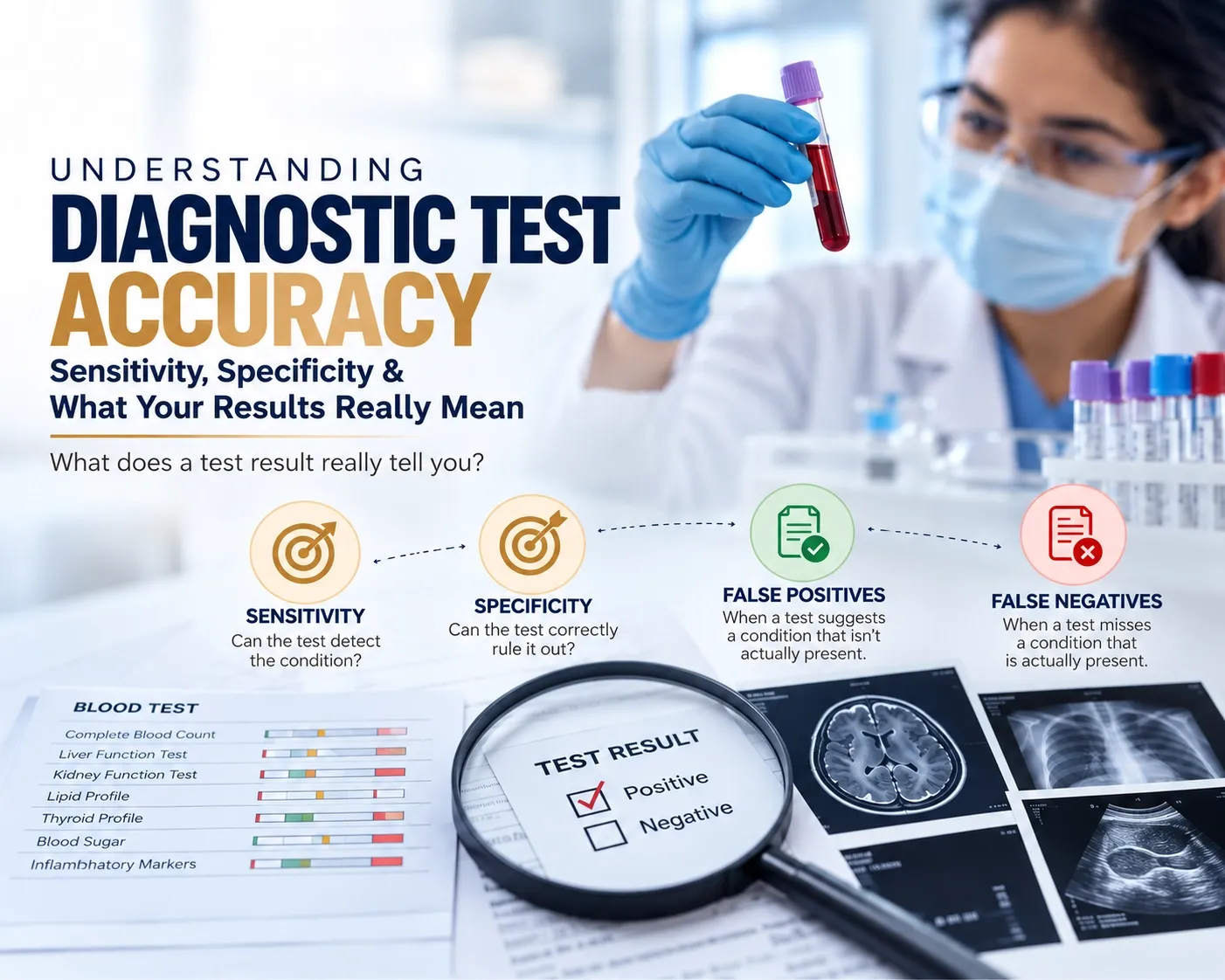
Understanding Diagnostic Test Accuracy: Sensitivity, Specificity & What Your Results Really Mean
A medical test result can sometimes feel difficult to understand. You may receive a report showing a normal, abnormal, positive or negative result and immediately wonder: “What does this actually mean?”
A diagnostic test is an important part of healthcare, but no single test provides the complete picture in every situation. Doctors interpret test results along with symptoms, medical history, physical examination and, when needed, other laboratory or imaging investigations.
One way healthcare professionals evaluate how well a diagnostic test performs is through concepts such as sensitivity and specificity. Understanding these terms can help patients better understand why a test may sometimes require confirmation or why a doctor may recommend additional testing.
What Is Diagnostic Test Accuracy?
Diagnostic test accuracy describes how well a test identifies a particular health condition compared with an appropriate reference or clinical standard.
A test may be designed to detect a disease, identify a particular substance or marker, monitor a health condition, or provide information that helps a doctor make a diagnosis.
However, no diagnostic test is perfect.
A test can sometimes produce:
- A true-positive result
- A true-negative result
- A false-positive result
- A false-negative result
The meaning of each result depends on the specific test and the clinical situation.
This is why a laboratory or imaging report should not be interpreted in isolation.
What Does a Positive Test Result Mean?
A positive result generally means that the test has detected the substance, marker, finding or condition it was designed to identify.
However, a positive result does not always mean that a person definitely has a disease.
Some tests can produce false-positive results. Depending on the test and the clinical situation, a healthcare professional may recommend another investigation to confirm or clarify the finding.
The appropriate next step depends on the test, symptoms, medical history and reason the test was performed.
What Does a Negative Test Result Mean?
A negative result generally means that the test did not detect what it was designed to identify.
However, a negative result does not automatically rule out every possible health condition.
The ability of a test to detect a condition depends on factors such as the characteristics of the test, timing and the clinical circumstances.
If symptoms continue or the clinical picture does not match the result, a doctor may recommend further evaluation or another test.
What Is Sensitivity?
Sensitivity describes how well a test identifies people who actually have the condition being investigated.
In simple terms:
High sensitivity = better ability to detect people who have the condition.
For example, if 100 people truly have a particular condition and a test correctly identifies 90 of them, the sensitivity in that example would be 90%.
The remaining people who have the condition but receive a negative result represent false-negative results.
Sensitivity is therefore closely related to the ability of a test to avoid missing cases.
What Is Specificity?
Specificity describes how well a test identifies people who do not have the condition being investigated.
In simple terms:
High specificity = better ability to correctly identify people who do not have the condition.
For example, if 100 people do not have a particular condition and the test correctly gives a negative result for 95 of them, the specificity in that example would be 95%.
The remaining people may receive false-positive results.
Sensitivity and specificity therefore measure different aspects of test performance.
Sensitivity vs Specificity: What Is the Difference?
The easiest way to remember the difference is:
Sensitivity focuses on people who have the condition.
Specificity focuses on people who do not have the condition.
A simple way to understand them is:
Test characteristicMain questionSensitivityHow well does the test detect people who have the condition?SpecificityHow well does the test correctly identify people who do not have the condition?
Neither measure should be considered alone when deciding whether a particular test is appropriate.
The clinical purpose of the test and the characteristics of the patient population also matter.
What Is a False-Positive Result?
A false-positive result occurs when a test indicates that a condition is present even though the person does not actually have that condition.
For example, imagine that a screening test indicates a possible health problem, but subsequent evaluation shows that the person does not have the condition.
This does not necessarily mean the original laboratory or diagnostic process was performed incorrectly. False positives can occur because of the characteristics of the test and the circumstances in which it is used.
Depending on the situation, additional testing may be recommended.
What Is a False-Negative Result?
A false-negative result occurs when a test does not detect a condition that is actually present.
For example, a person may have a particular condition, but the test result may be negative.
False negatives are important because they can occur with certain tests or under particular circumstances.
If symptoms or other clinical findings continue despite a negative result, the doctor may consider additional evaluation.
This is one reason why healthcare professionals do not rely only on one laboratory value or test result when evaluating a patient.
Why Can the Same Test Produce Different Results?
A person's test result can vary for many reasons.
Depending on the investigation, factors may include:
- Timing of the test
- Food and drink
- Fasting status
- Medicines and supplements
- Physical activity
- Sample collection
- Sample handling
- Biological variation
- Stage of a condition
- Laboratory methodology
For example, some laboratory measurements can be influenced by food intake, exercise, medicines or whether preparation instructions were followed.
This is why patients should follow the specific instructions provided for their investigation.
Does a Normal Result Mean Everything Is Fine?
Not necessarily.
A normal or negative result can be reassuring, but it should still be interpreted according to the purpose of the test.
Some tests are designed to detect a particular condition, while others provide broader information about a person's health.
A normal result from one investigation cannot automatically rule out every possible condition.
If symptoms persist, your doctor may decide that additional evaluation is appropriate.
Does an Abnormal Result Always Mean Disease?
No.
An abnormal result does not automatically mean that a person has a disease.
Laboratory reports commonly provide a reference range, but a result outside that range needs to be interpreted in context.
Reference ranges can vary depending on factors such as the laboratory, testing method and population.
Your doctor may consider the result alongside your symptoms, medical history, examination and other investigations before deciding what it means for you.
Why Doctors Sometimes Recommend More Than One Test
Different diagnostic tests provide different types of information.
For example:
Blood tests can provide information about cells, hormones, enzymes, proteins and other measurable substances.
Imaging tests can provide information about the structure and appearance of organs and tissues.
Functional tests can provide information about how a particular body system works under specific conditions.
Because these investigations answer different questions, a doctor may sometimes recommend more than one test.
This does not necessarily mean that the first test was inaccurate.
Instead, the additional investigation may provide information that the first test could not provide.
Screening Tests and Diagnostic Tests Are Not the Same
A screening test is generally used to identify people who may have a higher likelihood of a particular condition.
A diagnostic test may then be used to investigate a suspected condition more specifically.
This distinction is important because a screening result may indicate that further evaluation is needed rather than establishing a diagnosis by itself.
The appropriate testing pathway depends on the condition being evaluated and the individual's clinical circumstances.
Why Your Symptoms Still Matter
One of the most important points about diagnostic testing is that test results are only one part of the clinical picture.
A doctor may consider:
- Your symptoms
- How long you have had them
- Your medical history
- Family history
- Physical examination
- Previous test results
- Current laboratory results
- Imaging findings
- Response to treatment
Combining these sources of information can provide a more complete clinical picture than relying on one test alone.
How to Prepare for a Diagnostic Test
Preparation requirements depend on the specific investigation.
Some tests may require fasting, while others do not.
Some investigations may have specific timing requirements. Certain tests may also require information about medicines or supplements.
Before your test:
- Ask whether fasting is required.
- Follow the recommended fasting period if applicable.
- Follow any timing instructions.
- Inform the healthcare professional about medicines and supplements when relevant.
- Follow sample-collection instructions carefully.
- Ask the diagnostic centre if you are unsure about preparation.
Do not stop prescribed medicines unless your doctor specifically tells you to do so.
Following the correct preparation instructions can help reduce avoidable factors that may affect certain test results.
How Long Does a Diagnostic Test Report Take?
Reporting time depends on the specific investigation.
Routine laboratory tests may be available relatively quickly, while specialized laboratory tests and certain imaging investigations may require additional processing or interpretation time.
At Focus Diagnostics, patients should confirm the expected turnaround time for the specific test when booking or submitting a sample.
The reporting time should not be interpreted as a measure of the accuracy of a test. Speed and diagnostic performance are different concepts.
What Should You Do If You Do Not Understand Your Report?
Medical reports can contain technical terminology, abbreviations, reference ranges and numerical values that may be difficult to interpret without clinical context.
If you are unsure about your result:
- Read the test name carefully.
- Check the reference range provided by the laboratory.
- Look for any comments included in the report.
- Compare with previous results only when advised.
- Discuss the result with your doctor.
- Do not make a diagnosis based on one number alone.
Healthcare professionals can interpret the result according to your symptoms and medical history.
Can You Trust a Diagnostic Test Result?
Diagnostic tests are important tools in healthcare, but no test should be considered completely independent of its clinical context.
The performance of a test is evaluated using measures such as sensitivity and specificity, while the interpretation of an individual result also depends on factors such as the likelihood of the condition before testing and the patient's clinical circumstances.
This is why a test result should be viewed as one piece of clinical information, rather than an automatic diagnosis.
What Patients Should Remember
When you receive a diagnostic report, remember these five points:
1. A positive result does not always mean disease.
2. A negative result does not always rule out a condition.
3. Sensitivity and specificity describe different aspects of test performance.
4. Preparation, timing and other factors can influence certain test results.
5. Your doctor interprets the result together with your overall clinical picture.
Understanding these principles can make medical reports less confusing and help patients have more informed conversations with their healthcare professionals.
1. What is diagnostic test accuracy?
Diagnostic test accuracy describes how well a test identifies a particular condition compared with an appropriate reference or clinical standard.
2. What is sensitivity in medical testing?
Sensitivity describes how effectively a test identifies people who actually have the condition being investigated.
3. What is specificity in medical testing?
Specificity describes how effectively a test identifies people who do not have the condition being investigated.
4. What is a false-positive result?
A false-positive result occurs when a test indicates that a condition is present even though the person does not actually have that condition.
5. What is a false-negative result?
A false-negative result occurs when a test does not detect a condition that is actually present.
6. Does a positive test always mean that I have a disease?
No. Depending on the test, a positive result may sometimes require confirmation or further evaluation.
7. Does a negative test completely rule out a disease?
Not necessarily. The ability of a negative result to rule out a condition depends on the specific test and clinical circumstances.
8. Why might my test result change between two tests?
Results can vary because of biological variation, timing, preparation, medicines, physical activity, sample-related factors and changes in health status.
9. Should I interpret my laboratory report myself?
You can review your report, but medical interpretation should consider your symptoms, history and other relevant information. Discuss unexpected or concerning results with your healthcare professional.
10. Why might my doctor order another test after I already had one?
Different tests provide different types of information. An additional test may help clarify an uncertain finding, investigate another aspect of your health or provide information that the first test cannot provide.